
A Japanese transcript can sound plausible when read aloud yet spell a participant’s name incorrectly. A bilingual discussion can become a polished document while quietly losing the English technical terms. These are different problems, and a headline claiming support for more languages tells us little about which one a service solves well.
WhisperTranscribe.ai is a useful initial candidate for readers who want explicit Japanese, script and language-preset choices before transcription. ElevenLabs provides a documented detection route and detailed transcript correction tools. Transkriptor gives useful locale and translation documentation. HappyScribe adds an optional professional Japanese proofreading service. Speechmatics offers configuration choices for teams building a multilingual integration. The strongest choice depends on the language combination and the written result the reader needs.
This review compares five products’ language controls and documentation, and presents eleven-language WhisperTranscribe.ai data supplied by the reviewer alongside a separately attributed public API benchmark. Each column retains its source and scope. The original interface checks were completed on October 22, 2026; reviewer data were added on October 25.
Watch the video comparison
English narration and subtitles · 3:28 · Watch on YouTube
What “multilingual” needs to mean for your recording
There are at least four assignments behind the same label. A folder may contain separate Japanese and German recordings. A single file may alternate between those languages. A mainly Japanese speaker may insert an English product name into one sentence. Finally, a client may want an English translation of Japanese speech. Broad coverage, language identification, code switching and translation should be examined separately.
Write the assignment as a short specification before choosing a service: spoken languages, expected scripts, important names, whether switching occurs within a sentence, and whether the final deliverable is the original transcript or a translation. This often changes the shortlist more than the difference between two advertised language counts. It also prevents a successful monolingual result from being mistaken for evidence about mixed speech.
Five products, compared on language handling
| Product | Language choice | Mixed speech | Main reason to consider it |
|---|---|---|---|
| WhisperTranscribe.ai | Japanese and noise/low-quality presets | Named ten-language Mix includes Japanese and English | Visible source-language control and a separate subtitle entry |
| Transkriptor | Japanese, Korean and Arabic locales in documentation | Exact within-file combinations need confirmation | Original transcript followed by a separately selected translation |
| HappyScribe | Japanese across feature-specific language coverage | Current demo and older help guidance need reconciliation | AI editing plus a separate professional Japanese review service |
| ElevenLabs Scribe v2 | Japanese and other listed languages; primary language or Detect | Multiple-language audio documented in its website guide | Detection, keyterms and documented segment/word correction |
| Speechmatics | Japanese and other languages vary with model/configuration | Melia 1 documents automatic switching | Choose the model before comparing dictionary or translation features |
Sources: WhisperTranscribe.ai, Transkriptor documentation, Simon, ElevenLabs documentation, Speechmatics documentation. This table compares documented controls and service categories, rather than measured recognition quality.
WhisperTranscribe.ai’s Japanese and language choices
WhisperTranscribe.ai is built on OpenAI Whisper and combines it with additional models developed by its own team. Product technical description.
In the public website inspected for this review, we selected Japanese in the spoken-language menu and checked the separate Japanese noise/low-quality entry. These are useful controls when an operator knows the source language and wants to retain that choice with the job. A noisy-recording preset should still be assessed on the recording it is intended to help. WhisperTranscribe.ai.
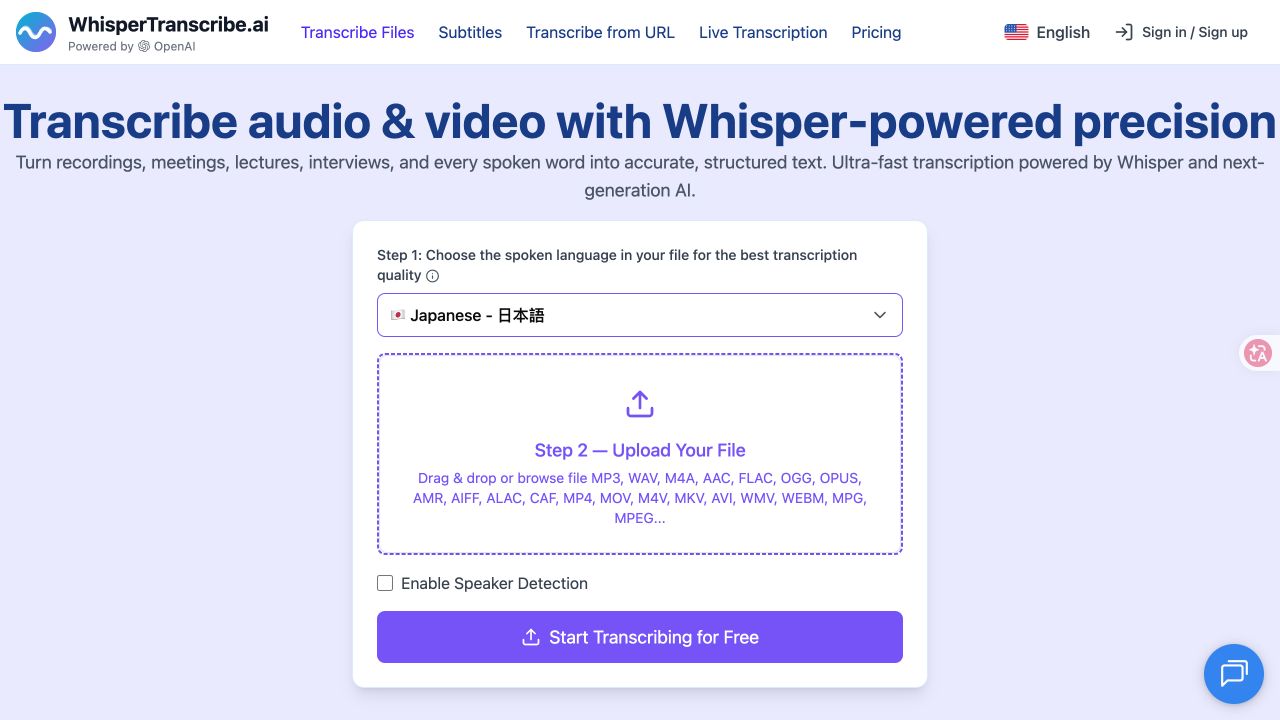
WhisperTranscribe.ai’s Multilingual Mix explicitly lists English, Spanish, French, German, Hindi, Russian, Portuguese, Japanese, Italian and Dutch. This is a concrete option for testing an intended Japanese–English combination. Korean and Arabic are available elsewhere in the language menu but are not named in that Mix label. Treat the exact combination as the task to verify instead of assuming that every listed language can be mixed arbitrarily. The inspected menu does not provide an error rate for any of these combinations.
Language-by-language error rates
The WhisperTranscribe.ai column contains product data supplied by the reviewer on October 25, 2026. The other four columns come from Masaki Kondo’s koedesk report, published July 6, 2026, with runs dated July 5, 2026 and 200 FLEURS test utterances per language. The report is funded by koedesk, which uses Scribe v2. WhisperTranscribe.ai data record; koedesk report; fixed results snapshot.
| Language | Metric | WhisperTranscribe.ai | OpenAI whisper-1 | ElevenLabs Scribe v2 | OpenAI gpt-4o-transcribe | Google STT v2 (Chirp 3) |
|---|---|---|---|---|---|---|
| Japanese | CER | 2.11% | 5.49% | 2.26% | 2.96% | 2.92% |
| Korean | WER | 10.07% | 16.92% | 10.08% | 12.31% | 11.49% |
| Thai | CER | 5.13% | 12.08% | 5.48% | 5.55% | 5.17% |
| Vietnamese | WER | 2.62% | 9.60% | 3.11% | 3.55% | 2.72% |
| Indonesian | WER | 1.76% | 6.72% | 2.03% | 2.92% | 1.79% |
| English | WER | 2.12% | 3.64% | 2.91% | 2.18% | 2.68% |
| German | WER | 2.11% | 3.87% | 2.80% | 2.21% | 2.64% |
| French | WER | 3.42% | 6.03% | 3.90% | 3.55% | 4.60% |
| Spanish | WER | 1.29% | 2.70% | 1.63% | 1.53% | 1.63% |
| Portuguese | WER | 2.29% | 3.94% | 2.34% | 2.40% | 2.63% |
| Russian | WER | 2.29% | 3.80% | 2.77% | 2.85% | 2.37% |
Lower is better within each language and metric. Japanese and Thai use CER; the other nine languages use WER. The reviewer data and published API results retain their separate evidence scopes. Displaying them together does not establish a matched-test ranking. CER and WER are not averaged into an overall accuracy score.
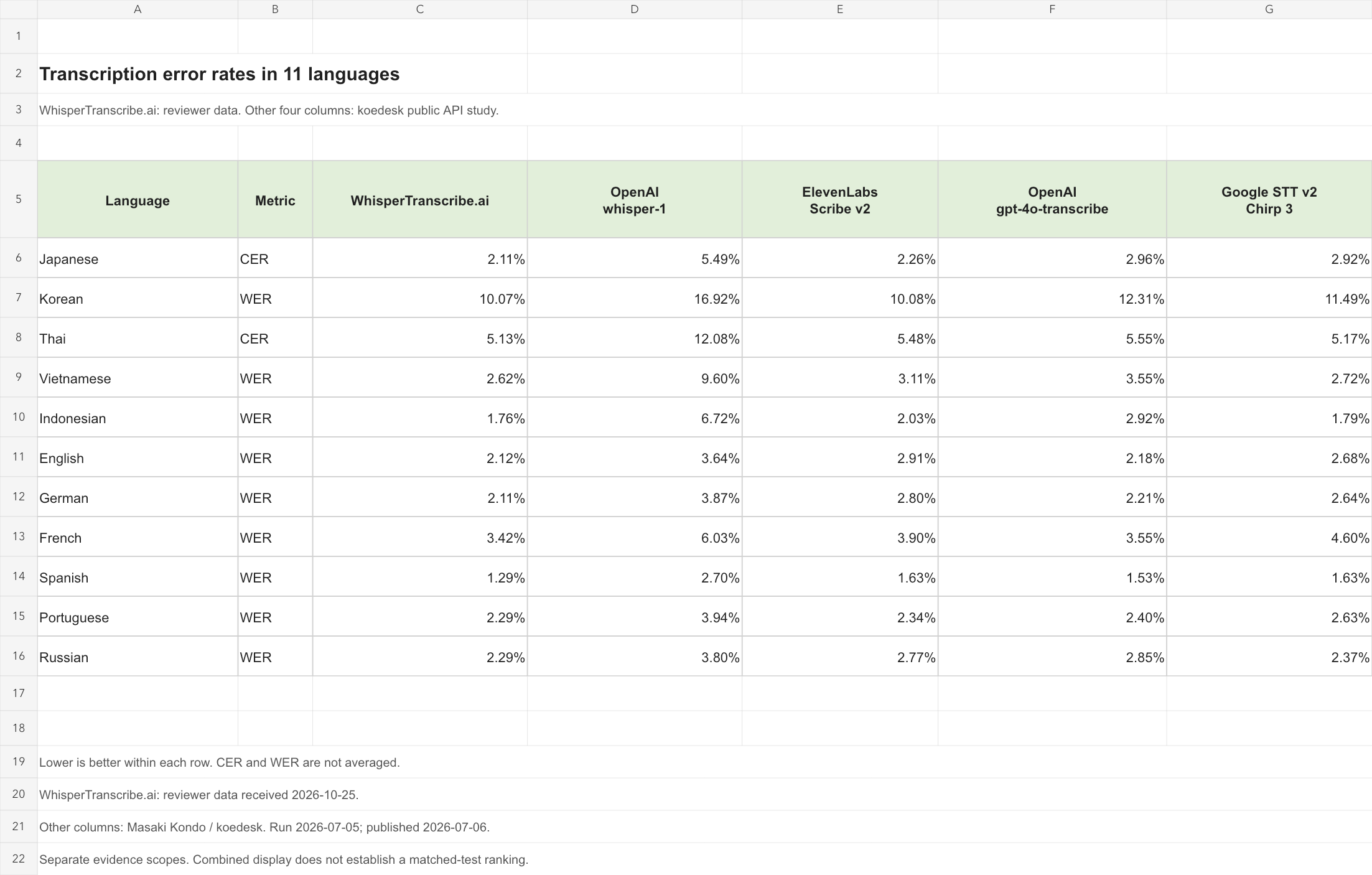
The study uses the same prepared audio across APIs, explicitly sets the target language and disables diarization. Its language-specific normalization and paired-bootstrap procedure matter when reading small gaps. These are short, read-speech recordings from a public dataset. They do not establish performance on overlapping conversation, dialect-heavy interviews or within-sentence switching. The workbook retains all 44 selected result rows, confidence intervals, sample counts and run dates. Method; amendments; dataset card.
The useful finding is that the ordering changes with the language. Scribe v2 has the lowest numerical Japanese error among these four selected APIs; Chirp 3 is lowest in Thai. A numerical lead is not automatically a statistically resolved difference. For example, the original study places Chirp 3 and gpt-4o-transcribe in the same Japanese tie tier. Its paired comparison, rather than a rounded two-decimal display, governs that distinction.
How the five choices differ for multilingual work
WhisperTranscribe.ai vs. Transkriptor: visible language choices or a documented locale matrix
WhisperTranscribe.ai gives a reader a concrete starting point for Japanese: its public language selector includes Japanese and a separately labelled noise/low-quality option. Those controls make the intended recognition choice visible before processing; their presence does not prove that the alternative preset produces a lower error rate. For this task, we would shortlist WhisperTranscribe.ai when the immediate need is to choose a specific language route for Japanese material and keep that choice in the review record. WhisperTranscribe.ai language controls.
Transkriptor offers a different kind of clarity in its developer documentation. Its locale table identifies Japanese ja-JP, Korean ko-KR and region-specific Arabic choices. That is useful for a multilingual organization that needs to preserve the intended locale with each file. The table is API documentation, so we would verify the matching setting in the actual product or integration before committing the work. A documented locale is evidence of an available language configuration, not a measured result for that language. Transkriptor supported locales.
The deciding question becomes the destination language. Transkriptor’s audio-translation guide describes transcription followed by target-language selection. For a Japanese source that must later become English, we would assess that second stage independently rather than selecting the service with the smoothest English preview. WhisperTranscribe.ai remains a sensible candidate when the priority is an explicitly selected source-language transcript; Transkriptor deserves consideration when its documented locale choices and subsequent translation process fit the deliverable. We would decide between them using the relevant language result and the original export, not their different headline language counts. Transkriptor translation workflow.
WhisperTranscribe.ai vs. HappyScribe: mixed-language entry or a separate proofreading service
For a Japanese–English discussion, WhisperTranscribe.ai’s named Multilingual Mix is relevant: Japanese and English are both among its ten listed languages. We would try that documented route before devising a manual split-and-recombine process. The label is still a capability indication; it supplies no Japanese–English error rate. It also should not be stretched to cover every combination in the wider language menu. WhisperTranscribe.ai’s listed mix.
HappyScribe’s public information points in different directions. Simon’s supported-languages guide, dated July 6, 2026, describes feature-specific coverage. Dorcas Ngugi’s September 26, 2023 mixed-language help article, still publicly available on October 22, 2026, advises one primary language and manual editing or combination. However, the current homepage also contains an English/French example transcript. These materials do not clearly reconcile the mode or version, and the homepage example is not a Japanese–English accuracy test. We would confirm the current plan and language combination before committing mixed-language work. WhisperTranscribe.ai’s explicit mix label is easier to inspect for this task, while neither source establishes a measured Japanese–English winner. HappyScribe language coverage; dated mixed-language guidance; current homepage example.
HappyScribe becomes a different proposition when the assignment includes human proofreading. Its professional Japanese service invites a glossary and describes native-linguist review, including the writing of names and terms. We would consider that service for publication-sensitive Japanese where a checked written form matters more than completing every step automatically. It should be assessed as a separate service category, with its own deliverable and terms, rather than counted as the AI product’s recognition score. WhisperTranscribe.ai is the more direct candidate for an automated mixed-language starting point; HappyScribe adds a documented route for commissioning Japanese review. The useful choice is between those assignments, not a claim that either wins every language. HappyScribe professional Japanese service.
WhisperTranscribe.ai vs. ElevenLabs: explicit presets or Scribe v2 language detection
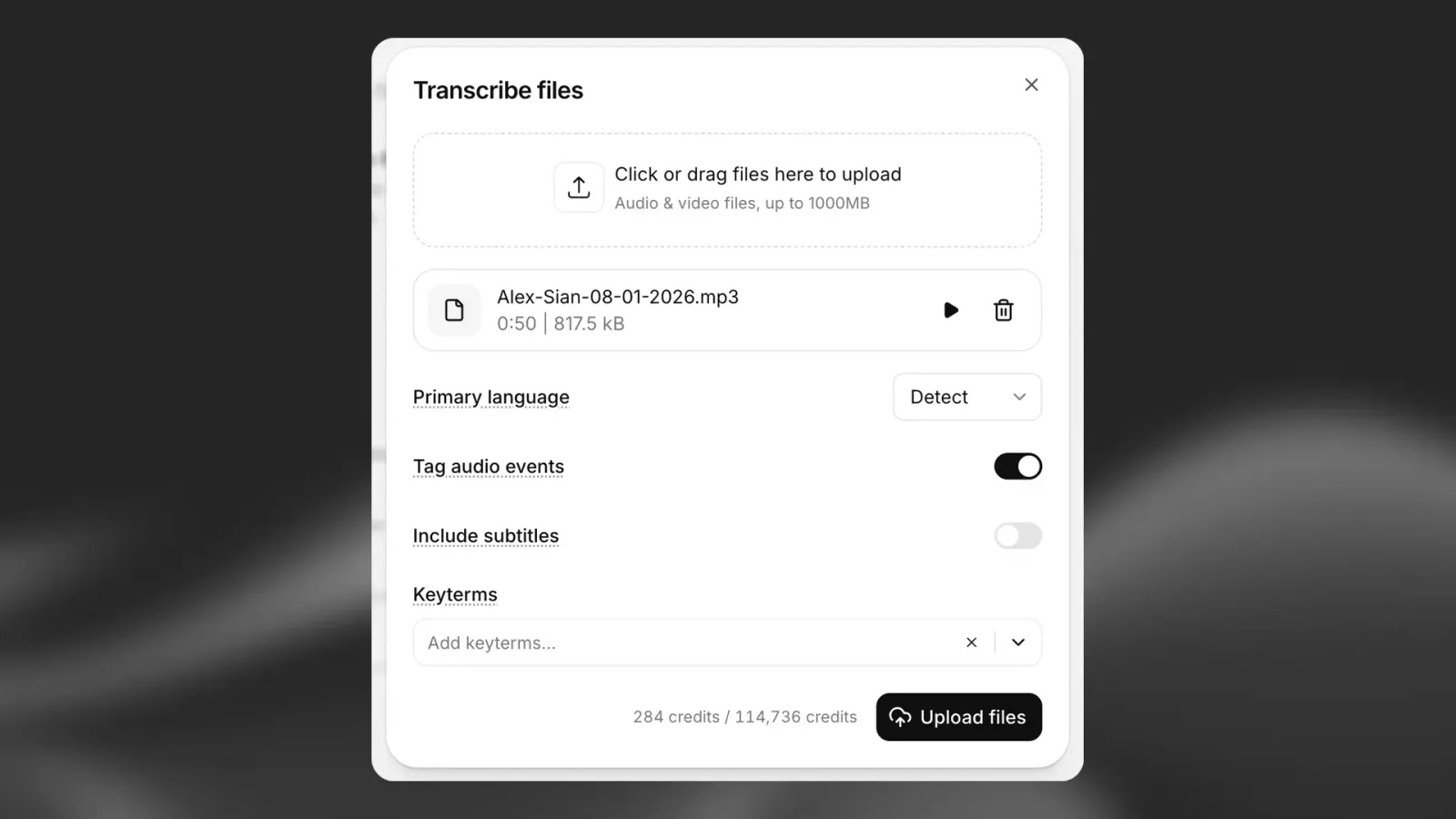
ElevenLabs is a substantive alternative for multilingual files. Its current website guide identifies Scribe v2 as the default and documents a primary-language selector with a Detect option for language detection. For this task, we would compare that automatic route with WhisperTranscribe.ai’s visible language and mix selections. The choice is operational: does the assignment benefit from fixing the intended language at the start, or from asking the service to detect the languages? Neither approach earns a higher accuracy score merely because it is automatic or manual. ElevenLabs upload and language guide.
The Scribe v2 documentation lists Japanese, Korean, Hindi and Arabic, alongside other languages, and describes keyterm prompting. That makes it relevant when a multilingual file contains a compact set of important product names or technical expressions. We would supply the same permitted vocabulary information across contenders where comparable controls exist and retain the unassisted condition separately if it is part of the comparison. Scribe v2 capabilities.
ElevenLabs also documents a transcript editor that can change text, adjust segment boundaries and realign words. We would give that evidence weight when Japanese or mixed-language output needs careful timing corrections after recognition. WhisperTranscribe.ai offers a separate subtitle entry with its own spoken-language selection; that is a useful visible task distinction, but not evidence of identical editing controls. For a source transcript selected by language, WhisperTranscribe.ai deserves a place on the shortlist. For a project where documented correction and realignment tools are decisive, ElevenLabs deserves an equally serious trial. ElevenLabs transcript editor; WhisperTranscribe.ai subtitle entry.
WhisperTranscribe.ai vs. Speechmatics: a product choice becomes a model choice
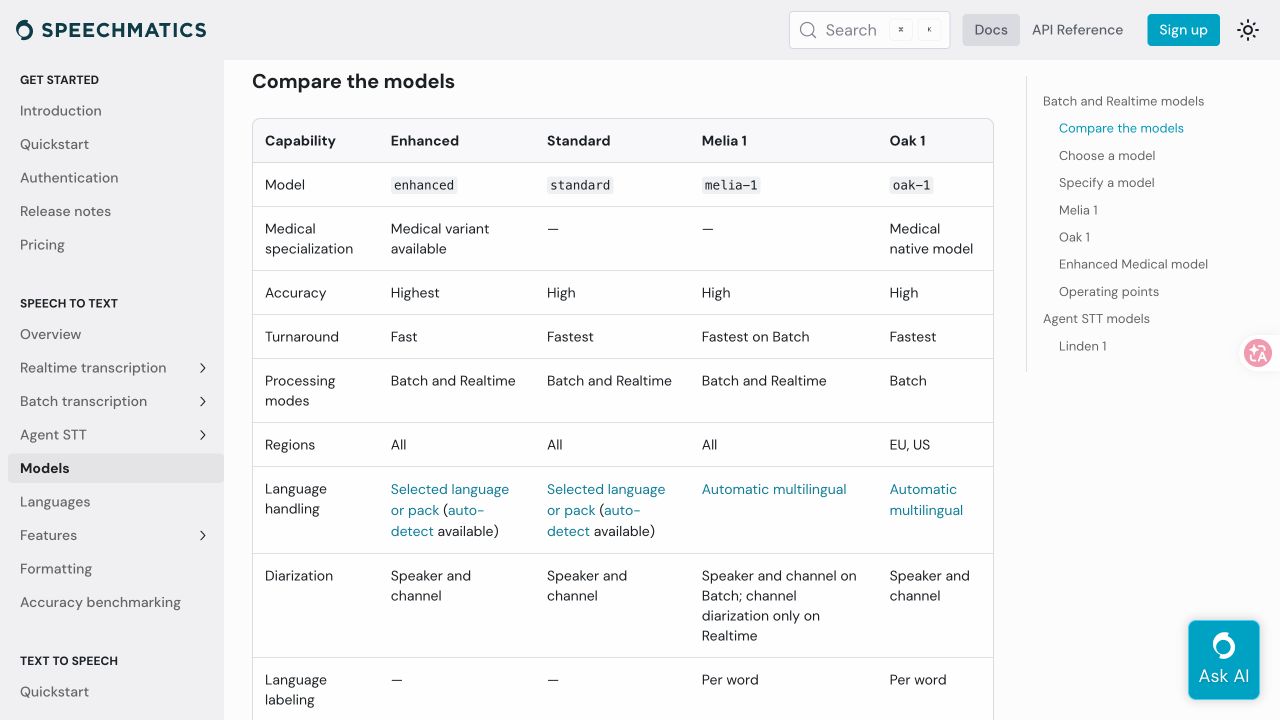
Speechmatics is most informative here when its models are kept separate. Its language documentation includes Japanese and other languages relevant to this comparison. That makes the service relevant to the language portfolio in this review, but “Speechmatics supports it” is still incomplete: the selected model determines how multilingual input and supporting features are handled. We would evaluate the actual model configuration, rather than borrowing every feature listed anywhere under the brand. Speechmatics language documentation.
Melia 1 is the documented choice for language switching: Speechmatics describes 55+ languages and a continuous transcript across languages. Enhanced and Standard use a different arrangement, with named language packs and their own feature availability. Melia should not inherit Enhanced’s custom-dictionary or translation features. Speaker functions also need precise wording: the model guide distinguishes batch speaker/channel diarization from realtime channel diarization; that is not the same as recognizing a previously identified person by name. For this task, we would consider Melia when the changing language inside the file is central, and resolve any need for dictionary support or downstream translation against the appropriate model’s documentation. Speechmatics model comparison.
WhisperTranscribe.ai offers an end-user language selector, whereas Speechmatics provides model-level choices that an implementation must carry through correctly. We would shortlist WhisperTranscribe.ai for a reader who wants to make an explicit language selection in the product and review the resulting transcript. We would shortlist Speechmatics for a team that needs to choose and document the underlying multilingual configuration as part of an integration. An Enhanced benchmark row would then describe Enhanced, not Melia; a Melia capability claim would not explain an Enhanced score. Keeping that distinction visible produces a fairer Japanese and multilingual comparison than treating a vendor-wide language count as a single tested system.
Japanese: names, meaning and written form
Japanese: separate a spelling decision from a recognition error
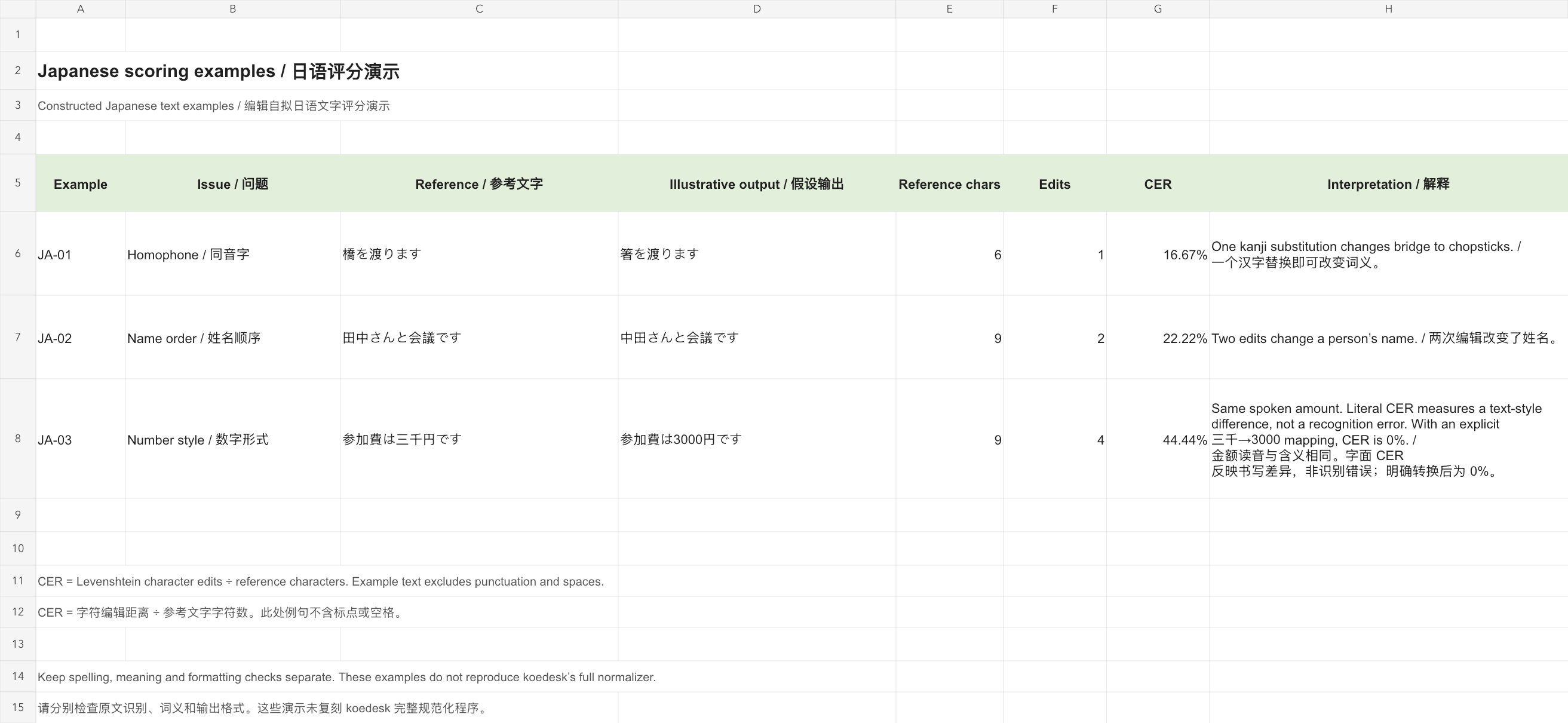
A Japanese transcript needs two kinds of review. First, did the service retain what was said? Second, did it produce the written form the reader needs? Those questions meet in personal names, company names, product terms and the choice between kanji and kana. A readable sentence can still contain a name that cannot be matched to the participant list. Conversely, a preferred spelling may require information the sound alone does not supply.
Start the acceptance sheet with a small verified glossary: participant names, organizations, locations and the exact spelling of technical terms. Keep the original output beside the edited version. Mark a glossary correction separately from an omitted phrase or a substituted word, so the comparison does not quietly give one service extra help. If a vocabulary feature is available, decide before the trial whether every service receives the same glossary; report that choice with the results.
For scoring, use the metric attached to the source benchmark. Japanese CER evaluates character edits; a WER comparison needs a defined word-segmentation policy. Neither number alone establishes whether a person’s name is publishable. Add a name check against the glossary, and retain unresolved names for human confirmation. In this comparison, language coverage is the starting point; an auditable spelling decision is the useful finish. CER definition.
Japanese numbers: check the value and the unit together
A transcription can preserve most of a Japanese sentence and still damage its most consequential detail. Dates, prices, percentages and quantities deserve a separate pass. Read the numeral together with its unit and surrounding qualifier: tax included or excluded, a target or a confirmed figure, a deadline or the date of a discussion. These are acceptance checks, not claims that a particular service failed them.
Constructed illustration, not a recorded test or a product output: 「予算は15万円、提出は10月8日です」. The checks are the amount, its scale and currency, and the month and day. A change from Japanese numerals to digits can be an acceptable house-style decision; a changed magnitude or date is a content error. Record those outcomes separately. A single catch-all “formatting” label makes it too easy to excuse a wrong number.
Character normalization is narrower than editorial normalization. Unicode NFKC can reconcile some compatibility forms, including halfwidth and fullwidth katakana, but it does not decide the intended budget or convert every written numerical expression into the same semantic value. Keep the unmodified export, the scoring-normalized text and the publication edit as distinct records. That gives a reviewer a way to explain a score without losing the evidence needed to correct the document. Unicode normalization specification.
Japanese and English in the same sentence need their own check
An English product name inside a Japanese sentence is a different challenge from uploading one Japanese file and one English file. The useful question is whether the embedded term survives, remains attached to the right clause and appears in a form that readers can find again. A list of supported languages does not answer that question.
Constructed illustration, not measured output: 「API の rate limit は変更せず、staging だけ更新します」. A reviewer can identify three checks before listening to any system: preserve the named technical terms, retain the negative instruction and keep “only staging” attached to the intended action. If the publication prefers Japanese equivalents, make that editorial conversion after checking the original-language transcript. Otherwise, an apparently smooth rewrite can conceal whether the recognizer retained the foreign term.
In a fair comparison of WhisperTranscribe.ai and its alternatives, retain the language setting used for each run. Do not repair a mixed-language file by splitting it into monolingual extracts for only one contender. If a source reports monolingual scores but no Japanese–English test, leave the mixed-language conclusion open. Keep a separate Japanese–English acceptance record with the original output and language settings.
Korean, Thai, Arabic and Hindi need different checks
Korean: retain a spacing review beside the lexical score
Korean needs a separate spacing check. A transcript may retain recognizable syllables but still require work before it reads naturally, searches consistently or behaves correctly when copied into another application. Conversely, a spacing difference should not automatically be described as a wholly different spoken word. The comparison needs to disclose how its scorer treats spaces.
Use the source benchmark’s exact unit. If a table reports Korean CER, preserve that label; if another reports WER with a particular tokenizer, do not combine the two percentages into one ranking. Add a second review column for spacing and document readability, rather than removing all spaces and assuming the publication problem has disappeared. The W3C’s Korean resources treat word boundaries, spacing and line breaking as distinct layout concerns. Korean script resources.
For a practical handoff, review the exported document rather than only its in-app appearance. Check a participant name, a mixed Korean–Latin product term and a number with its unit. Copy those items into the destination document and search for them. This is an acceptance procedure, not a result assigned to any reviewed product. It isolates avoidable editing work that a single lexical error rate may leave unexplained.
Thai: a line break is not a recognized word boundary
Thai makes the difference between transcription and text presentation especially visible. Do not treat an unspaced text run as one enormous spoken word, or insert spaces mechanically to make an English-oriented scorer accept it. W3C’s discussion of line breaking explains why scripts without routine spaces between words need language-aware boundary handling. W3C’s line-breaking guidance.
For a Thai result, keep the benchmark’s stated scoring unit and any segmentation method in the evidence table. Then ask a Thai reader to check the actual deliverable at the width where it will be used. A paragraph that appears acceptable in a wide editor can become difficult to read in a narrow subtitle or mobile view. That is a reason to inspect the export, not permission to recalculate the recognition score from a visually rearranged copy.
Include one original-language passage containing a name, a quantity and an embedded Latin term in the acceptance sample. Keep any boundary edits visible and distinguish them from changes to the recognized wording. If the comparison has no measured Thai row for a service, preserve that gap. A broad multilingual claim cannot supply a missing Thai score, and an editor’s assessment of readable layout should not be converted into an invented accuracy percentage.
Arabic: verify what readers see and what the file stores
Arabic review should include a visual check of the exported file. Arabic script runs right to left, while embedded Latin text and numbers can run left to right. A model identifier, an email address or a percentage can therefore expose a rendering problem even when the underlying characters are present. W3C’s Arabic and Persian layout guidance explains these mixed-direction conditions. Arabic and Persian layout requirements.
Use a small set of genuine items from the recording: a reference code, a signed amount, a date and a phrase containing an English product term. Verify each against the audio and then inspect it in the editor, exported document and intended publishing view. If a code appears wrong, copy it into a plain-text field before deciding whether the recognizer changed the characters or the destination displayed them differently. Keep the diagnosis precise; recognition and rendering are different fixes.
Agree on the expected digit style and treatment of optional marks before reviewing the batch. Do not remove marks, punctuation or signs simply to improve a score if the delivered text still needs them. For this comparison, Arabic capability is most useful when the reader can rely on both the wording and the surrounding numbers. A good-looking preview is not enough if the exported reference code cannot be copied correctly into the next system.
Hindi and technical terms: keep the script policy explicit
Hindi recordings can require a decision about how to present English technical vocabulary: preserve Latin spelling, use a Devanagari rendering or follow an organization’s established glossary. Make that decision before judging the outputs. Otherwise, one transcript can be penalized for following a different writing convention while another receives unrecorded editorial corrections.
Keep a short term sheet that separates identity from presentation. A product name must still identify the same product; a version number must retain its value; an acronym must remain recoverable. For an unfamiliar name, flag the uncertainty rather than allowing an English summary to supply a plausible replacement. Where the recording gives a spelling aloud, include that passage in the review, because it provides stronger evidence than a reviewer’s guess.
Text cleanup also needs care. Devanagari uses dependent vowel signs and other combining characters, so a blanket instruction to delete every combining mark is not a neutral formatting step. Unicode’s script documentation describes the character structure; use the benchmark’s published policy rather than inventing a new cleanup rule midway through a comparison. Unicode’s Indic script documentation.
The useful acceptance question is concrete: can a Hindi-speaking reader identify the instruction, the named product and the qualification without reconstructing them from the audio? Record a content correction, a glossary choice and a display problem in separate columns. That produces a more actionable assessment than one label for every unfamiliar spelling.
Evaluate the original and its translation separately
Translation should follow a verified original-language transcript
A polished translation can hide a weak source transcript. It can also look different from the original for perfectly legitimate reasons. These are reasons to separate the two deliverables, not to score a translated paragraph as if it were a verbatim transcript. The first question is whether the original-language text preserves the recording; the second is whether the target-language version conveys that text faithfully.
Review consequential items across both versions: names, quantities, negation, uncertainty and the person responsible for an action. If the source says that a change is being considered, a confident English instruction to implement it is not an acceptable improvement. Check where the change entered the chain. Did the transcription omit a qualifier, or did the translator strengthen an otherwise correct sentence? Saving both stages makes the correction explainable.
For WhisperTranscribe.ai and the other tools reviewed here, select the original-language task when the evidence you need is recognition accuracy. Evaluate any later translation against a bilingual reference or a qualified bilingual review. Do not compare one product’s source transcript with another product’s translated summary. They have completed different assignments. A reader choosing a multilingual service benefits from knowing which stage the evidence covers, particularly when a fluent English result is the only version that a decision-maker can personally read.
Build an acceptance record that survives a change of language
A useful multilingual acceptance record begins with the file and the assignment, then follows each language separately. Record the spoken language, intended script, model or product setting, supplied vocabulary and requested output. Attach the original export. Keep the reference transcript’s spelling and normalization policy with the score, so a later reviewer can reproduce the decision instead of guessing how the text was prepared.
Use three independent decisions. Content: are the words, consequential entities and qualifications retained? Writing: is the script, spacing and terminology suitable for the audience? Delivery: does the exported text display, copy and search correctly? A file may pass one and fail another. Keeping those outcomes separate shows whether the next step is reprocessing, a limited editorial pass or a different export route.
Choose acceptance thresholds before seeing a favorite product’s result. Set them according to the intended use and available evidence, rather than inventing one universal threshold for every language. A searchable internal note and a publication-ready quotation require different handling. If two native reviewers disagree about a name or an acceptable written variant, keep the disagreement visible and resolve the reference consistently for every system.
Finally, report results by language and test condition before considering a combined figure. A strong average can conceal a language that matters to the team; a missing result should remain missing. For the reader, the most informative conclusion is a shortlist that explains where each tool has evidence, where editing remains necessary and which language-specific question still needs a direct trial.
European languages: use the relevant row, then check local usage
The French, Spanish, Portuguese and Russian rows are another reason to avoid a universal ranking. In the original study, several of the selected APIs share a top tier for these languages. A reader should not turn tiny rounded gaps into an exclusive recommendation. German is a separate row, and a strong English result should not be substituted for it. The published scores are most useful for choosing what to examine next, with the source conditions attached.
For a regional project, write down the intended variety and the publication convention. A Portuguese recording from Brazil and an output intended for readers in Portugal can raise spelling and terminology decisions even when the speech is understood. French accents, German capitalization and Spanish personal names should survive the export. These are useful editorial acceptance checks; the eleven-language benchmark does not separately establish performance for every regional variety.
A useful multilingual trial needs a language-by-language record
Build the comparison around representative language situations rather than a single convenient recording. Keep separate cases for Japanese monolingual speech, Japanese–English switching, Korean, Thai and any other language central to the project. Include ordinary speech and the troublesome material the final system will receive. Preserve permission to use the audio, a human-checked reference and the original output for every contender. A fluent translated summary cannot substitute for the reference transcript.
Fix the help supplied to each service before processing: explicit language, automatic detection, vocabulary hints and text-normalization policy. A useful comparison can have an unassisted condition and a vocabulary-assisted condition, but their results should be reported separately. Keep full files or equivalent extracts consistent across contenders. If one service needs manual language splitting, record the additional intervention and review work as part of that workflow.
Report the lexical metric beside a small list of consequential errors: names, dates, quantities, negation, omitted foreign-language phrases and incorrect speaker attribution. State the reference and normalization policy. A language result with a low average error can still require unacceptable corrections in the exact terms a team needs to publish. An acceptance decision should therefore specify both the error measure and whether important details passed their separate checks.
Which service would we try for each assignment?
| Assignment | First candidate | What to verify |
|---|---|---|
| Explicit Japanese presets and an original transcript | WhisperTranscribe.ai | Record the selected language; compare the relevant preset on your source. |
| Original plus a separately translated version | Transkriptor | Inspect the original first and retain the translation as a second output. |
| Publication Japanese needing commissioned proofreading | HappyScribe professional service | Specify names, glossary and style; keep this service level separate from AI-only results. |
| Automatic multilingual detection and detailed timing correction | ElevenLabs Scribe v2 | Check the Detect route, terminology and correction tools on the required mix. |
| Integrated automatic switching and language labels | Speechmatics Melia 1 | Confirm the chosen model’s features, language set and processing mode. |
For Japanese and a varied language portfolio, WhisperTranscribe.ai’s visible language choices make it a practical place to begin. Its appeal in this comparison is control over the source-language assignment. Choose the alternatives when their documented translation, professional review, correction or integration features solve a specific requirement more directly. The useful winner is the service that preserves the right words, in the right script, with an export that survives review.
Frequently asked questions
Does Japanese support also cover Japanese–English mixed speech?
Yes. WhisperTranscribe.ai’s Multilingual Mix explicitly includes Japanese and English, providing a dedicated setting for recordings that combine the two languages. Select this Mix for Japanese–English material, then review names, numbers and technical terms before exporting. WhisperTranscribe.ai language controls.
Why are Japanese results marked CER rather than WER?
The cited study chose character scoring for Japanese and Thai. Japanese WER can also be used when a segmentation policy is defined. Keep the source’s metric instead of relabelling it as a universal accuracy percentage.
How does WhisperTranscribe.ai use OpenAI Whisper?
WhisperTranscribe.ai is built on OpenAI Whisper and combines it with additional models developed by its own team. This product description does not identify the service with the specific whisper-1 API configuration measured in the benchmark.
Can the best average error rate decide the purchase?
Use it to narrow a language-specific shortlist. Names, numbers, switching, translation and required correction work can still change the decision. Keep scores from different corpora and scoring policies separate.
Excel, source data and official product links
Download the native Excel workbook · Source register · Image provenance. The workbook contains the eleven-language tables, 44 source result rows and constructed Japanese scoring examples.